Human Captured

Capturing humans in the post-trust net. Scroll for captions.

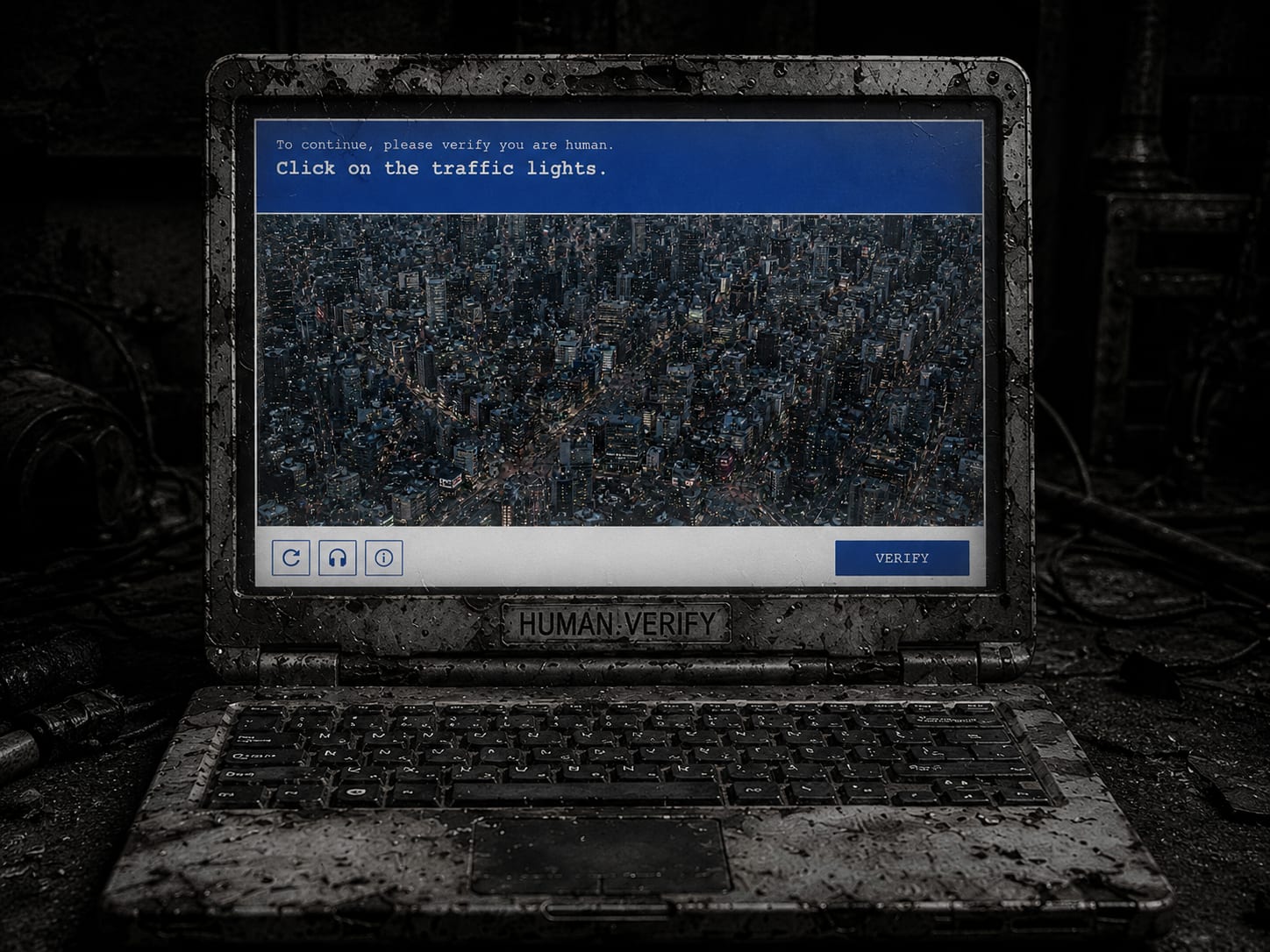
Click on the Traffic Lights

Click on the Traffic Lights

A familiar CAPTCHA instruction becomes quietly oppressive when scaled across an impossibly dense city. The task appears simple, yet the image overwhelms the viewer with distance, ambiguity and visual noise. This piece examines the absurd labour of proving humanity through machine-vision tasks, where human attention is converted into tiny acts of classification. The traffic light becomes both object and obstacle: a symbol of order inside a system that withholds access until the user performs correctly.
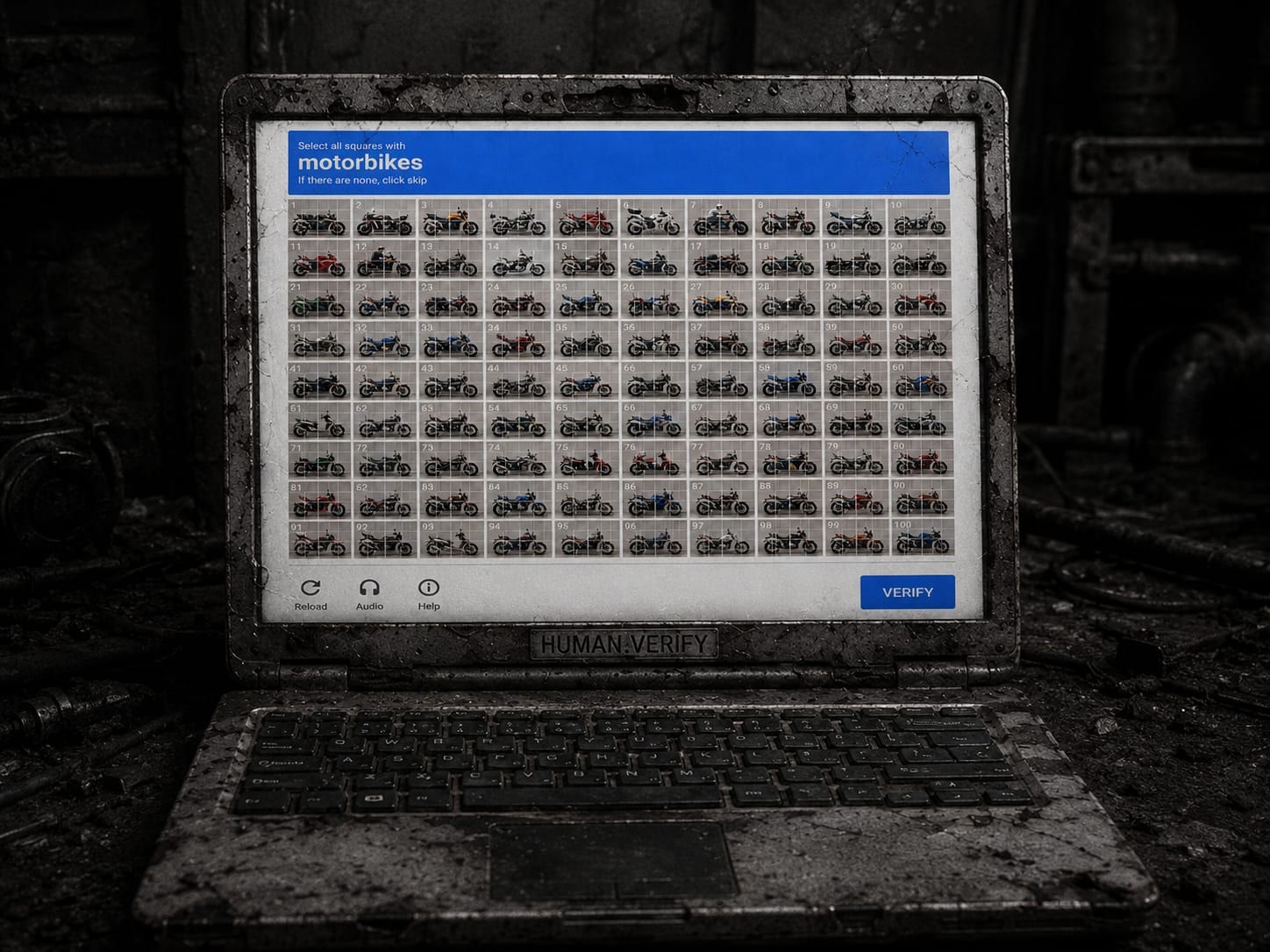
Select All Squares With Motorbikes

Select All Squares With Motorbikes

This work pushes the CAPTCHA grid to the point of exhaustion. Each motorbike is divided, repeated and fragmented until verification becomes an act of endurance rather than recognition. The piece comments on the hidden productivity cost of digital life: the countless seconds spent proving we are human to systems that increasingly fail to recognise us. What looks like a security check becomes a field of unpaid visual labour, where every click trains the machine that questions us.

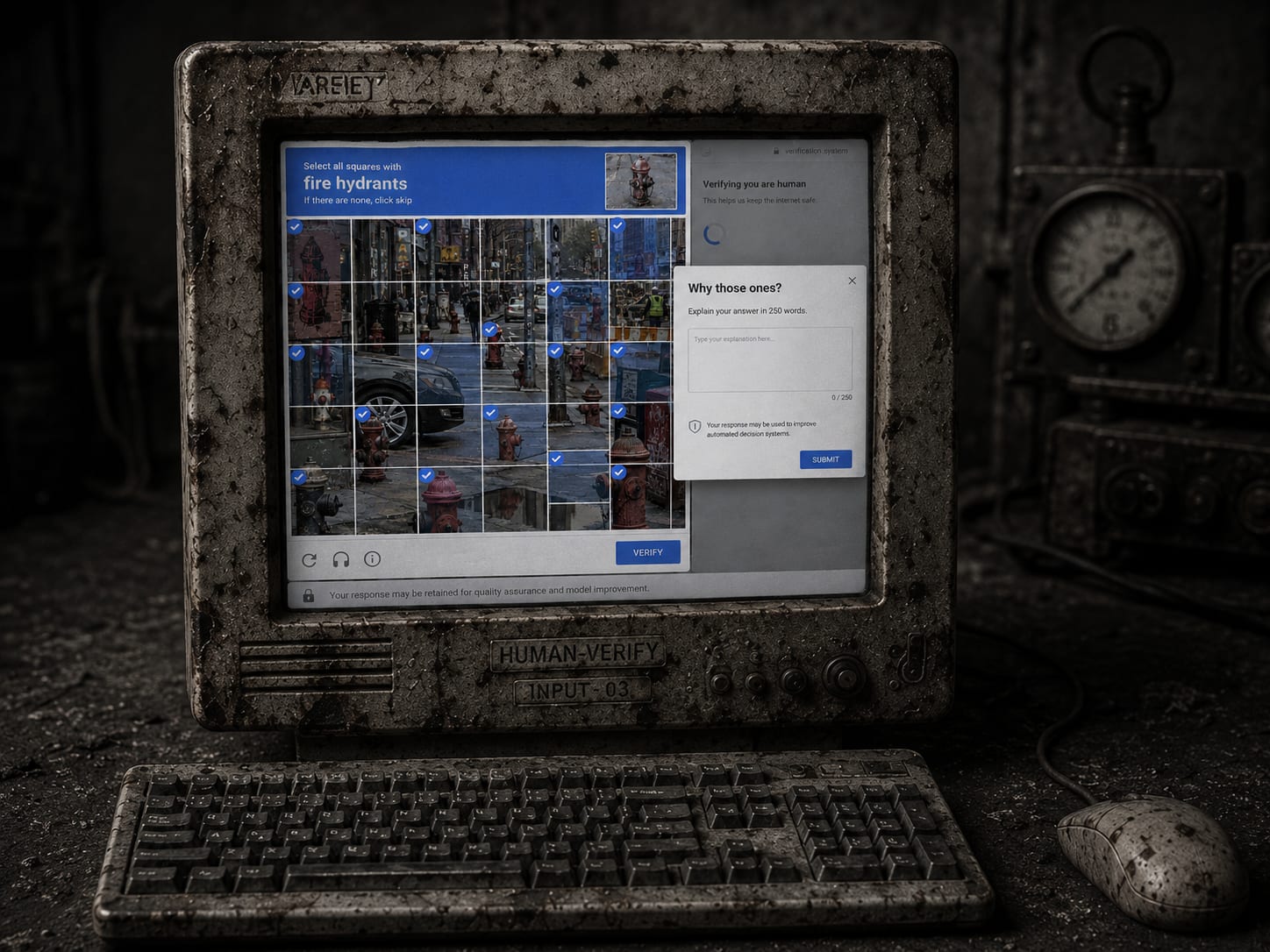
Select All Squares With Fire Hydrants

Select All Squares With Fire Hydrants

Here, the user has completed the task, yet the system demands justification. The absurd pop-up — “Why those ones?” — turns a simple image-selection CAPTCHA into an interrogation. The piece reflects the creeping expansion of verification: first recognition, then explanation, then compliance. By asking the user to defend obvious choices in 250 words, the work exposes the bureaucratic cruelty of automated systems that ask for human judgement while refusing to trust it.

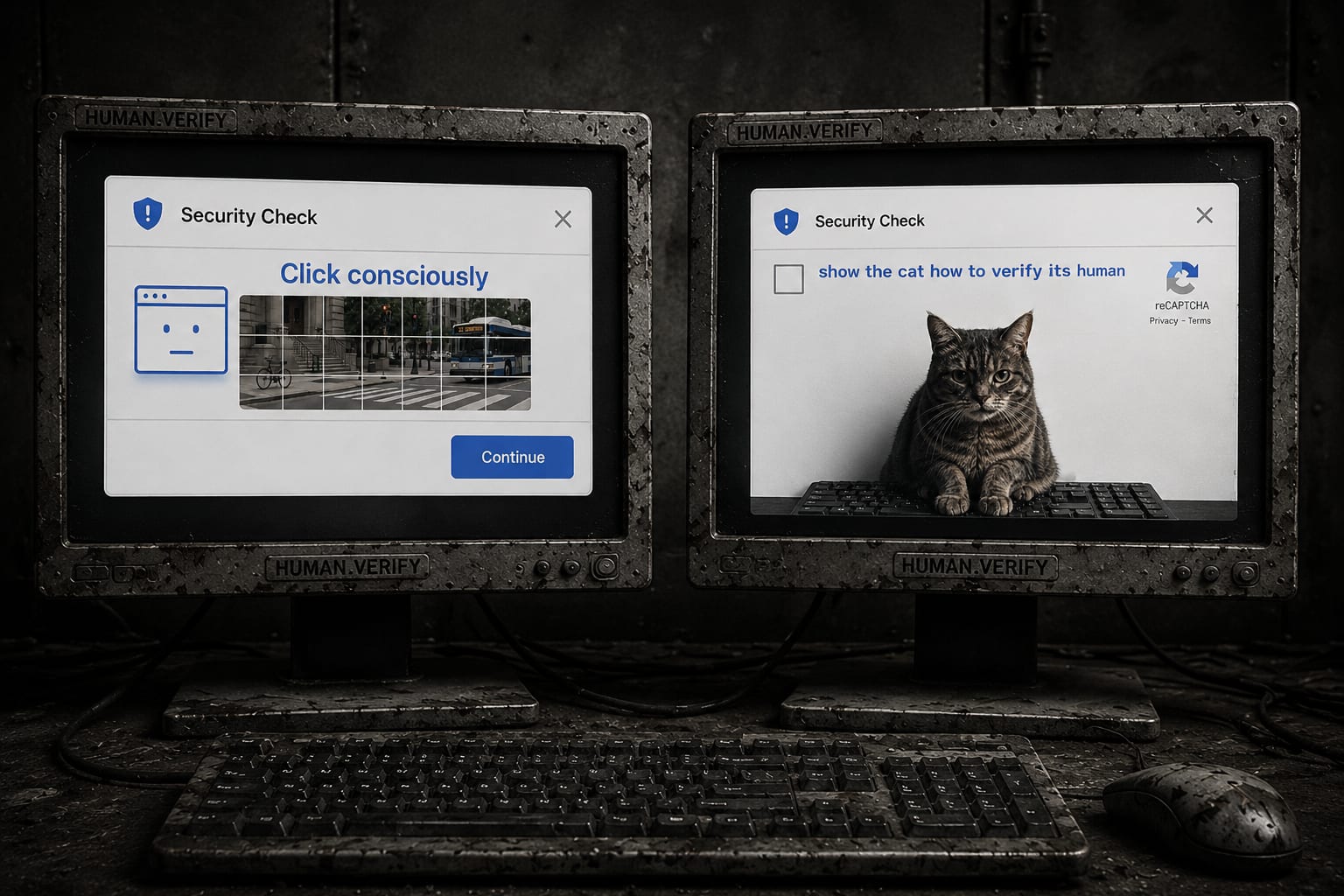
Show the Cat How to Verify Its Human, beside Click Consciously

Two pieces, shown together.

Show the Cat How to Verify Its Human

A cat sits calmly at the keyboard while the interface asks the impossible: “show the cat how to verify its human.” The humour is immediate, but the reversal is unsettling. The human is absent, the animal is centred, and the machine waits for proof. The piece plays with the collapse between user, observer and subject in digital culture, asking what happens when non-human intelligences begin learning the rituals humans use to authenticate themselves.

Click Consciously

The instruction is no longer to find a bus, bike or traffic light. Instead, the user is told to “click consciously.” The piece shifts the CAPTCHA from object recognition into psychological surveillance. It reflects a world where systems increasingly evaluate behaviour: hesitation, rhythm, cursor movement, confidence and doubt. The work asks what it means to perform humanity under observation, when even a click may be judged for its intention.

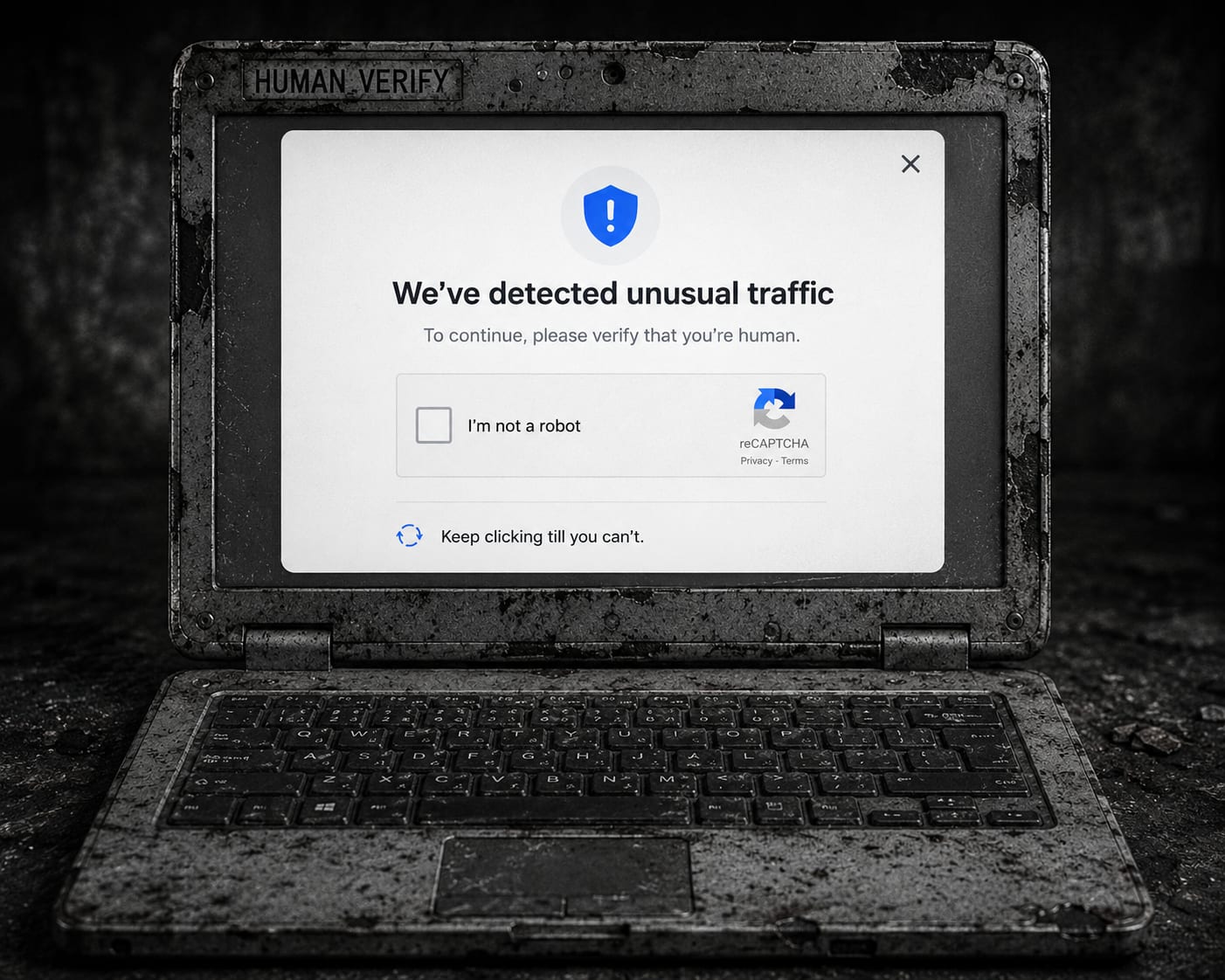
We’ve Detected Unusual Traffic

We’ve Detected Unusual Traffic

This piece borrows the sterile language of modern security pop-ups and turns it into an endurance command. “Keep clicking till you can’t” transforms verification from a temporary interruption into an infinite loop. The work reflects the anxiety of being flagged by invisible systems: suspected, measured and delayed without explanation. It asks how much repetition, patience and compliance are now required simply to be treated as a legitimate human user.

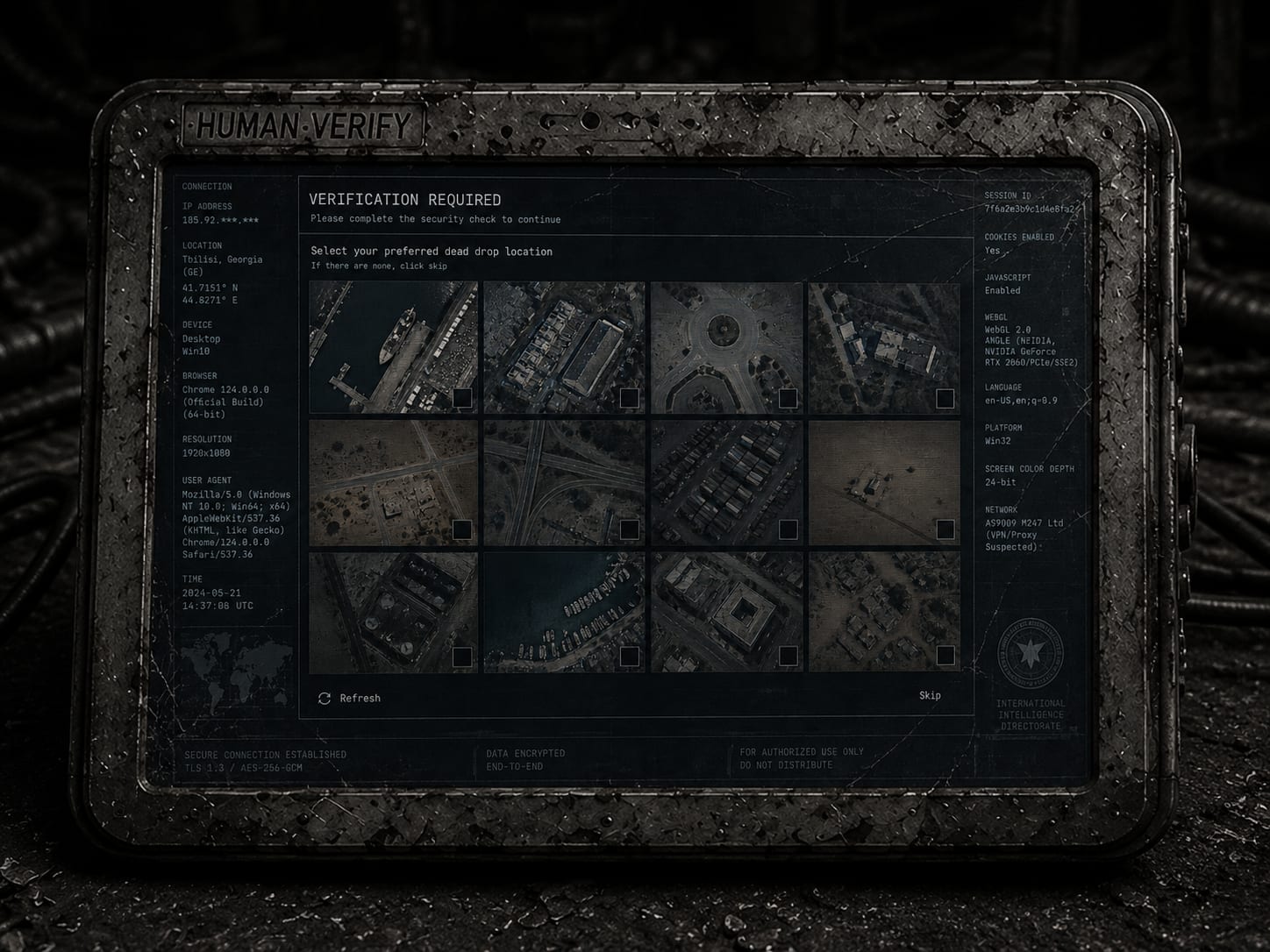
Select Your Preferred Dead Drop Location

Select Your Preferred Dead Drop Location

A dark intelligence-style CAPTCHA asks the user to choose a “preferred dead drop location.” Satellite views, telemetry panels and surveillance overlays turn the verification ritual into a trap. The piece imagines a system that has already outsmarted the person trying to remain hidden. It merges the language of cybersecurity, dark web paranoia and state surveillance, asking whether anonymity can survive once every interface becomes a sensor.

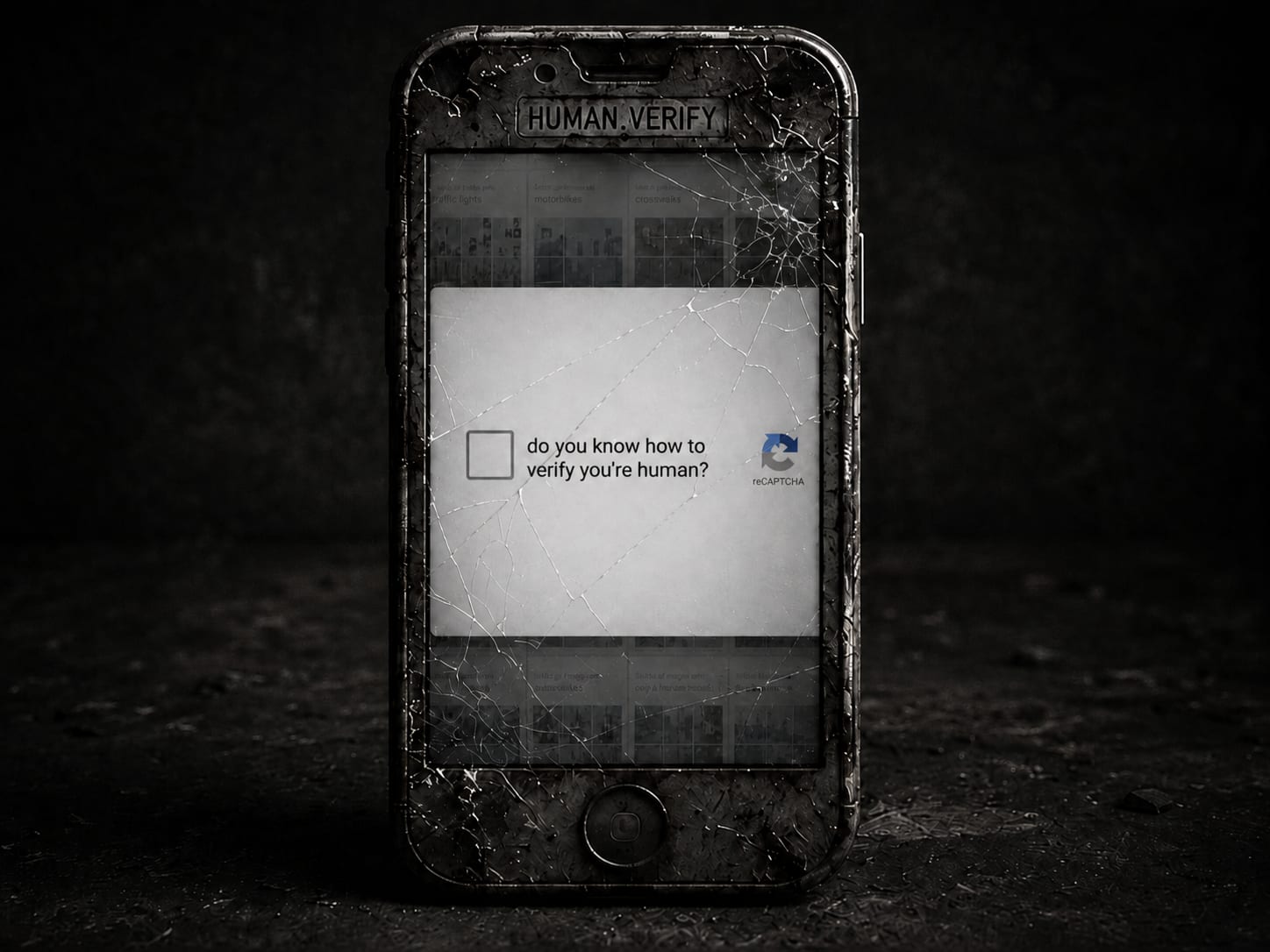
Do You Know How to Verify You’re Human?

Do You Know How to Verify You’re Human?

The final image reduces the CAPTCHA to a checkbox and a question. There is no puzzle, no grid and no correct answer — only a demand for self-verification. The wording feels slightly broken, as if generated by a system imitating human language. As a closing piece, it strips the ritual back to its existential core. In a world where machines increasingly imitate perception, language and behaviour, who decides what being human looks like?